
India is shining, although I will argue that it is a temporary acceptance until India once again makes a mega-successful film like RRR or another beautiful, moving, documentary like The Elephant Whisperers, notes Aseem Chhabra.

Declining vegetable prices brought down the retail inflation to a 15-month low of 4.59 per cent in December and within the comfort zone of the Reserve Bank, government data showed on Tuesday. It is for the first time during the current fiscal that the Consumer Price Index (CPI) based inflation print is below 6 per cent or in the RBI's target range of 2 to 6 per cent. The central bank factors in the CPI-based inflation while arriving at its monetary policy. The inflation in December 2020 came down from 6.93 per cent in November, mainly on account of 10.41 per cent decline in vegetable prices over the year-ago period.

If people can lobby me for making changes in policies that goes against the country's interest, I won't keep myself in this position, says the vice chairman of NITI Aayog.

India's industrial production grew by 1 per cent in December, official data showed on Friday. According to the Index of Industrial Production (IIP) data, the manufacturing sector output grew by 1.6 per cent in December 2020.

Most rating agencies had projected contraction in India's GDP for the first quarter of 2020-21.

BSE-listed companies' market capitalisation reached Rs 197.7 trillion on January 21, against India's nominal GDP of Rs 190 trillion during 12 months ended December 2020.

'This encourages escapism through the politics and economics of nationalism, made worse by tribalism or nativism, the package accompanied inevitably by the erosion of institutional bulwarks and therefore State capture by powerful businessmen,' notes T N Ninan.

Chief Justice of India (CJI) D Y Chandrachud's first 100 days in office saw the Supreme Court take a giant leap towards reforms, especially making courts more technology-friendly, and ensuring relatively fast judicial appointments including those of eight judges to the apex court.

The researchers analysed 2580,021 test results from nose and throat swabs taken from 384,543 participants aged 18 years or older between December 1, 2020 and May 16, 2021.

The NCEAR has indicated some improvement in the fourth quarter of the current financial year.

Concerned by GDP slowdown and unrealistic tax targets, the economists urged Finance Minister Nirmala Sitharaman to implement long-term structural steps like land and labour reforms. Warning against any off-Budget financing the economists said the government should prepare a statement of intent for its social, rural and welfare sector expenditure.

Addressing a virtual Downing Street press conference, Boris Johnson acknowledged the divided views on lifting all lockdown restrictions to declare that his update does not imply that the pandemic "is over".

India's factory output climbed 22.4 per cent in March, benefiting from the base effect of the lockdown-marred month a year back as well as a turnaround in the manufacturing sector, while retail inflation slipped to a three-month low of 4.29 per cent in April. The high positive annual growth in the index of industrial production (IIP) in March 2021 came on back of a contraction of (-)0.9 per cent and (-)3.4 per cent in January and February 2021 respectively, according to the data released by the National Statistical Office (NSO) on Wednesday. This turnaround was led by recovery in the mining, manufacturing and electricity sectors.

China's covid crisis could provoke a raw material crunch for India's EV industry later this year.

The substantially increased economic dualism may exert lasting negative influences which could include a reduced potential for economic growth; the persistence of a very weak employment and poverty situation; rising social and political discord; and heightened vulnerability to geopolitical challenges, cautions Shankar Acharya, former chief economic adviser to the Government of India.

'They forget that denial of basic rights has helped create a big political void which is adding to a deepening alienation.' 'This creates a fertile ground for extremist elements and targeted killings which we are witness to once again.'

The technical report of the NSSO has generated controversy following its observation that as much as 36 per cent units forming part of MCA-21 database, used in computing GDP, could not be either identifiable or traceable in the field.
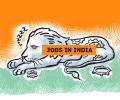
The problem of unemployment is spread across the economy.

There should have been a focus on sanitation and not on littering or garbage. Absence of sanitation affects the health of children, explains Aakar Patel.

Expect a more modest out-turn of around 5 per cent (if not less) because of the longer-term scarring effects of the Covid shock, the sharply slowing growth in the pre-Covid years and some scepticism about the growth-efficacy of some of recent official policy initiatives, explains Shankar Acharya, former chief economic advisor to the government.

Public sector banks have lost nearly Rs 2.85 lakh crore on account of loan dues of 13 corporates even as the banks are used to bail out ailing financial institutions such as Yes Bank and IL&FS, United Forum of Bank Unions alleged on Monday. In a press release, UFBU's convener B Rambabu said the organisation calls for a two-day all India bank strike on December 16 and 17 protesting against Banking Laws (Amendment) Bill 2021 and opposing the Centre's alleged move to privatise PSBs. According to the statistics given by the UFBU, the 13 corporates' outstanding dues were at Rs 486,800 crore and it was resolved at Rs 161,820 crore resulting in a loss of Rs 284,980 crore.

The Seventh Pay Commission had decided to choose the CPI-IW as the index for adjusting inflation for central government employees.

Nearly 3.64 lakh educated and "semi-educated" youngsters had registered with employment exchanges across Gujarat till December 2021, according to state government data.
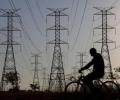
Most of the economic activity in the country had come to a standstill after the government imposed a 21-day nationwide lockdown beginning March 25 to check the spread of coronavirus.

His celebratory gesture on Thursday night marks a first for Downing Street, which annually sees the UK prime minister host a Diwali gathering and an Annakut, or spread of festive food, from London's Swaminarayan Mandir next door at No 10.

India's industrial production contracted by 3.6 per cent in February, official data showed on Monday. According to the Index of Industrial Production (IIP) data released by the National Statistical Office (NSO), manufacturing sector output declined by 3.7 per cent in February 2021. Retail inflation rose to 5.52 per cent in March, mainly on account of higher food prices, government data showed on Monday. The consumer price index (CPI) based retail inflation stood at 5.03 per cent in February.

Macroeconomic management is usually a lot more comfortable with lower fiscal deficits. The sooner we get there, the better for the economy, says former Chief Economic Adviser to the Government of India Shankar Acharya.
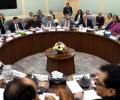
India's likely medium-term potential growth will almost certainly be markedly lower than that experienced in pre-pandemic years, warns Shankar Acharya, former chief economic advisor to the Government of India.

A total of 254 millionaires from India have used the so-called "golden visa" to settle down in the UK through a large investment into the country since the route opened in 2008, according to a new report released by a UK-based anti-corruption charity on Monday. Spotlight on Corruption said that Indians ranked as the seventh nationality of super-rich to have availed of the Tier 1 (Investor) Visa, adding up to 254 between 2008 and 2020. China topped the list at 4,106, followed by Russia (2,526), Hong Kong (692), the United States (685), Pakistan (283) and Kazakhstan (278) ahead of India.

The Reserve Bank's growth projection for next financial year is lower than 8-8.5 per cent projected by the finance ministry in the recent Economic Survey which was tabled in Parliament on January 31. Unveiling the bi-monthly policy, RBI governor Shaktikanta Das said, "Recovery in domestic economic activity is yet to be broad-based, as private consumption and contact-intensive services remain below pre-pandemic levels."

To enable widen the fiscal deficit beyond the permissible limit under the present legislation, the government may have to propose amendment to the FRBM Act in the Finance Bill.

The panel finds 'discrepancy' in the Annual Survey of Industries data.

India's GDP estimates for 2020-21 show that the economy is expected to perform much better than earlier projections by different agencies, indicating a sustained V-shape post-lockdown recovery, experts said. The first Advance Estimates (AE) by the National Statistics Office (NSO) has projected a contraction of 7.7 per cent in the real GDP during 2020-21. This was better than the projections by certain international agencies like the IMF and World Bank.

India's economy recovered faster than expected in the September quarter as a pick-up in manufacturing helped GDP clock a lower contraction of 7.5 per cent and held out hopes for further improvement on better consumer demand. The gross domestic product (GDP) had contracted by a record 23.9 per cent in the first quarter of the 2020-21 fiscal (April 2020 to March 2021) as the coronavirus lockdown pummelled economic activity.

The Bill states a worker will be paid twice his or her wage if he or she is allowed to work overtime. A majority of workers in India worked more than 48 hours in a week, which is higher than the International Labour Organisation's prescribed time-limit.

'We are looking at the Budget with the hope that it will address all issues even at the cost of exceeding the fiscal deficit target.'

Beside manufacturing, deceleration was also witnessed in sectors like agriculture, construction and electricity, gas and water supply.

Lalpura, who took over as the National Commission for Minorities (NCM) chairperson last week, asserted that his priority would be to dispel 'false narratives' fuelling insecurity among minorities.
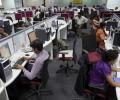
However, the government has enacted an important change to the fixed-term employment framework that may help companies in handing out contractual jobs to its existing permanent workforce.
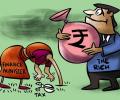
While the tax-to-GDP ratio of 9.88 per cent has been assumed for FY21, the same as last year, when it touched a decadal low, for FY22 a ratio of 10.7 per cent has been assumed, an average of the last five years.
 © 2026 Rediff.com - Advertise with us - Disclaimer - Privacy Policy - Sitemap - Feedback - About us - Terms of use - Grievances